Your search returned 405 results

video

Triangle Puzzle Brain Teaser

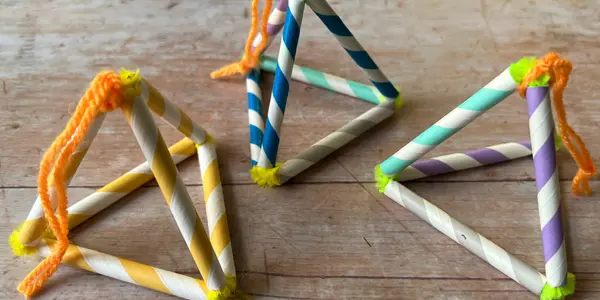
In this video, we show you how to make a fun geometric brain teaser. You will need a square piece of paper, a ruler, a pencil, and a pair of scissors. Then find a willing volunteer to solve the puzzle. It's not as easy as it looks!

Sumdog Times Tables Pack

Best suited for First and Second Level

A good understanding of times tables, and the ability to recall them quickly, is an essential foundation for children’s learning. So at Sumdog, we've made all our practice tools fun and engaging!

Download our free Times Tables pack to access our Pathway to Multiplication Success, lesson plans and times tables cards to use during Maths Week Scotland.

Active Times Table Challenge

Best suited for First and Second Level

Make learning fun by working together in your classroom or at home to get a high score in physically active times tables.

  • Copy the presenter's actions while chanting times tables
  • Solve the on-screen challenge quiz questions correctly for more points
  • Easy to use 10-minute sessions, ideal for a lesson starter or practising at home

The Times Table Challenge resources are available completely FREE for two weeks. After this, you will keep a subset of sessions; if you would like to help your learners master times tables with all resources you can upgrade your subscription.

video

Lego Symmetry Puzzles

Puzzles are a fun way to learn about symmetry, and you can make your own out of Lego bricks and a base board. For younger kids, use Duplo bricks and simple patterns, for older kids use regular Lego bricks and make the patterns more challenging.

Online Talk: Environmental Statistics

Best suited for First and Second Level

When we build wind farms, what happens to the wildlife? In this interactive talk, statistician Katherine Whyte looks at how we can use maths and statistics to help us balance the benefits of wind energy with the risks posed to ocean wildlife like seals and seabirds. Where were the animals before we built the wind farm, and how many were there? How many animals leave when a wind farm is built, and do they come back? What do animals do when they are near a wind farm, and can they still find enough food in the sea?

Statistics is an important tool in helping us to answer these questions, and helping us make decisions that are both good for the planet and good for our local wildlife.

Part of the Royal Statistical Society's William Guy Lecture Series

video

Maths War Card Game

Maths War is a great little game to practice different kinds of maths skills, including number values, place value, addition and multiplication. All you need is one of two packs of regular playing cards, with the face cards (Jack, Queen, King) removed.

Online Talk: From sweets to streets: Understanding the world through statistics

Best suited for First and Second Level

Numbers can be found everywhere. This talk provides an opportunity to learn more about how statistics can help us understand the world around us, with a strong emphasis on making the examples fun, engaging and applicable to anyone.  

Illustrated examples are provided throughout the talk, supplemented with ideas for practical activities and topics for class discussion. The talk can be watched in one go, or each section can be used to support learning and spark follow-up discussion separately. 

Part of the Royal Statistical Society's William Guy Lecture Series

video

Tower of Hanoi

Time to get your scissors & paints out to create your own Tower of Hanoi puzzle - and then of course you'll have to solve it! But don't worry, we've included the solutions at the end of the video. You can try it with 3, 4 or 5 discs.

Online Talk: Little Bo-Peep has lost her mother duck – what nursery rhymes teach us about AI

Best suited for First and Second Level

The introduction to the talk will cover the types of AI that children might encounter, including generative AI systems such as ChatGPT.  Principal Data Scientist Rebecca Duke will then show how you can use nursery rhyme lyrics to build your own generative AI, starting with a simple algorithm based on the most popular combinations of words and increasing the complexity using random chance. The last section of the talk will discuss some of the positive and negative aspects of generative AI to help children to become more informed and responsible users of the technology. 

Part of the Royal Statistical Society's William Guy Lecture Series

video

Geometric Dot Grid Drawings

Pencils at the ready! Using dot grid paper to create pictures, connect adjacent dots vertically, horizontally or diagonally to create geometric drawings.

If you don't have any dot grid paper, you can download and print off some for free via the link below. Or you can use graph paper and connect the corners of the squares instead.

Numberella Interactive Adventure

Join Numberella, Ronnie Resist, Miss A Go and The Thief in an exciting interactive adventure that will take you deep into the jungle of the lost world of Meravilium. Use your maths skills to help the adventurers outwit the mysterious talking creatures who guard the great pyramid… and help them discover the secrets that lie inside!

There are two difficulty levels to choose from, one for the 7-10 age group and one for the 11-14 age group. Everyone who completes the adventure wins a certificate!

Pier Arts Centre activities

Best suited for First and Second Level

Explore four artworks from the Pier Arts Centre collection with these art activity sheets. Explore shapes and composition through the work of Ben Nicholson, three-dimensional paper folding inspired by Jim Lambie, Mobius loops through the work of Barbara Hepworth, and geometric drawing inspired by Steven MacIver.

Artwork credit: Steven MacIver, Akasaka, 2010

video

Number Doodles

Best suited for First and Second Level

Numerical doodles are a fun way for children to gain more confidence in recognising and naming numbers. Older learners can also still have fun getting creative. Try your hand at recreating our doodles, or create your own - what can you turn each number in to? We have a Christmas version in our seasonal Family Activities section too.

video

Pyramid Addition & Multiplication

Best suited for First and Second Level

Pyramid is a card game for two or more players. The video shows Pyramid addition, but the same game play can be used for multiplication. For either version, you will need a standard set of cards with the face cards (Jack, Queen, King) removed.

video

Maths War

Best suited for First and Second level

Maths War is a great little game to practice different kinds of maths skills, including number values, place value, addition and multiplication. It works best with 2-4 children. All you need is one of two packs of regular playing cards, with the face cards (Jack, Queen, King) removed.

'Trash' Card Game

Best suited for First and Second Level

The card game 'Trash' (also known as 'Garbage') is great for number recognition and for practicing number sequences. It can be played with standard playing cards (1 pack of cards per every 2 players).

video

Flip 3 Equations Game

Best suited for First and Second Level

This is a great card game for practicing simple equations, including addition, subtraction, multiplication and division. All you need is one deck of regular playing cards, with the face cards (Jack, Queen, King) removed.

'Sevens' Dice Game

Best suited for First and Second Level

Sevens is a dice game for two or more players, that encourages number and quantity recognition, and basic addition skills.

video

'Tenzi' Dice Game

Best suited for First and Second Level

Tenzi is a dice game for two or more players, which is great for number recognition. You will need a set of ten dice per player.

video

'Pig' Dice Game

Best suited for First and Second Level

Pig is a dice game for two or more players. It's what's known as a jeopardy game, where you have to decide whether to jeopardise previous points gained by rolling again to gain even more points. As well as practicing basic maths skills counting up your scores, Pig teaches you to think strategically.

Shut the Box

Best suited for First and Second Level

Shut the Box is a dice game for two or more players, and is great for encouraging number recognition and practicing addition and number bonds. It can be played with standard playing cards instead of the traditional box.